Digital Notarization: How It Works & Legal Status
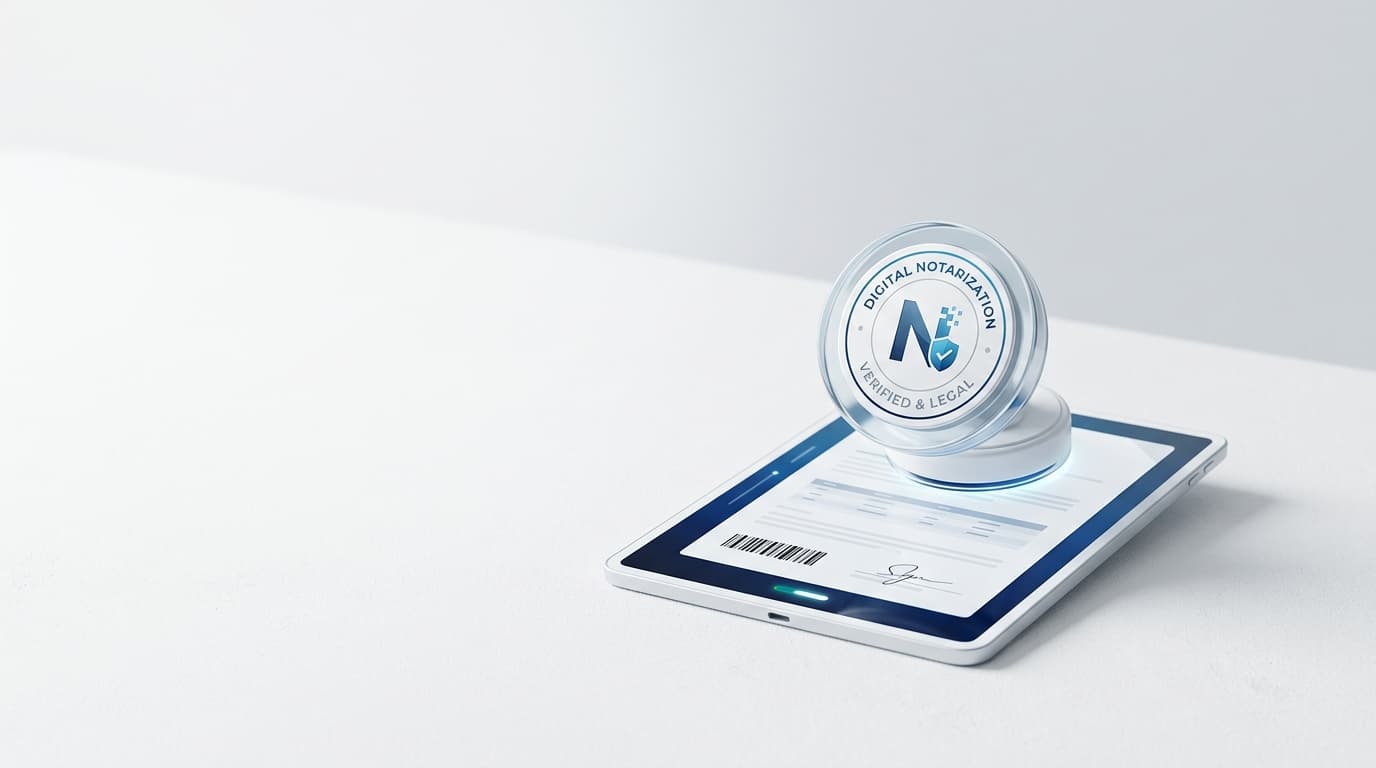
What Is Digital Notarization and How It Works
Digital notarization is the process of notarizing documents remotely through live video sessions using electronic signatures, identity verification technology, and digital seals instead of traditional wet-ink signatures and rubber stamps. Also known as remote online notarization (RON), this modern approach maintains the core legal purpose of traditional notarization—verifying the signer's identity and witnessing the signing—while leveraging technology to make the process faster, more convenient, and more secure.
The typical digital notarization session follows a straightforward workflow. First, you upload your document in PDF format to the notarization platform. Next, you verify your identity through a two-step process that combines credential analysis of your government-issued photo ID with knowledge-based authentication questions drawn from public records. Once verified, you connect with a commissioned notary through a live video call where you can see, hear, and speak to one another in real time. During the session, you apply your electronic signature to the document, and the notary then applies a tamper-evident digital seal using a digital certificate that embeds a digital fingerprint in the PDF. This seal allows anyone to verify that the document has not been altered after signing and guarantees the notary's identity.
The entire process typically takes 10 to 20 minutes from start to finish. You can download your completed, legally notarized document immediately after the session ends. Unlike traditional notarization, digital notarization creates a comprehensive record that includes a video recording of the session, a timestamped audit trail of every action taken, and an electronic copy of the notarized document—providing a more detailed record than paper-based methods.
For those seeking convenient eNotary services, digital notarization eliminates the need to schedule appointments days in advance or travel to physical locations. This makes it particularly valuable for busy professionals and anyone without easy access to traditional notary services.
Identity Verification and Security Requirements
Digital notarization employs a rigorous three-factor authentication process that often exceeds the security standards of traditional in-person notarization. The first factor, credential analysis, uses advanced optical character recognition (OCR) and fraud detection tools to scan and verify the authenticity of your government-issued photo ID. The system examines security features, validates the ID format against known templates, and checks for signs of tampering or forgery.
The second factor is knowledge-based authentication (KBA), which presents you with "out-of-wallet" questions compiled from public and private data sources such as credit reports, transaction history, and marketing data. These questions are generated in real time and require personal knowledge that would be difficult for an imposter to answer correctly without intimate familiarity with your financial and personal history. To participate in KBA, you must have a valid U.S. Social Security number or Individual Taxpayer Identification Number (ITIN) and at least six months of credit history.
The third factor involves the live video session itself. The notary visually confirms that the person on camera matches the photo ID presented and observes your signing in real time. This audio-visual component satisfies the traditional face-to-face requirement while creating a permanent video record of the interaction.
Most government-issued photo IDs are accepted for digital notarization as long as they are physical (not digital copies), unexpired, and clearly readable. You must be at least 18 years old to participate. Your device—whether computer, phone, or tablet—must have a working webcam and microphone, though no special software download is typically required since most platforms operate through standard web browsers.
The security infrastructure extends beyond identity verification. Digital notarization platforms use encryption to protect data transmission, secure servers to store session recordings and documents, and digital certificates issued by trusted certificate authorities to create tamper-evident seals. According to Proof's documentation, these combined security measures create a more fraud-resistant process than traditional notarization, where a notary might accept a cursory glance at an ID without advanced verification tools.
Legal Validity and State-by-State Availability
Digital notarization is legal in 49 states plus the District of Columbia as of 2026, with California being the sole outlier. California's permanent RON statute is scheduled to take effect on January 1, 2030, meaning residents of all 50 states will soon have access to this technology. Importantly, RON laws govern notaries rather than signers, so you can use an online notary regardless of which state you live in. A notary commissioned in Florida, for example, can legally notarize documents for a signer in New York or Texas.
Interstate recognition statutes ensure that digital notarizations performed by state-approved online notaries are valid across state lines. As long as the notary follows the rules of the state in which they are commissioned, the notarization is typically recognized as valid in other states under these reciprocity provisions. This legal framework has been strengthened by federal legislation and model laws promoted by the National Notary Association, which have encouraged states to adopt compatible RON statutes.
Digital notarizations carry the same legal weight as traditional in-person notarizations for most document types. These include real estate transactions, powers of attorney, wills, trusts, affidavits, and business contracts. Courts, government agencies, and financial institutions increasingly accept digitally notarized documents, particularly as the technology has matured and adoption has grown. The tamper-evident digital seal provides verifiable proof of authenticity that can actually be easier to validate than a physical rubber stamp, which can be forged or applied to altered documents.
However, some document types and jurisdictions may still require in-person notarization. Certain states exclude specific documents from RON eligibility, such as wills or living trusts, though these restrictions are becoming less common as legislatures update their statutes. International documents may face additional scrutiny, and some foreign governments or institutions may not yet recognize digital notarizations. It's worth checking whether your specific document type and intended use are compatible with digital notarization, though the vast majority of common notarization needs are fully supported.
The legal infrastructure continues to evolve rapidly. According to NotaryLive's state-by-state analysis, the trend is clearly toward broader acceptance and standardization of digital notarization laws, driven by consumer demand and the proven security benefits of the technology.
Cost Comparison: Digital vs. Traditional Notarization
Digital notarization typically costs between $25 and $50 per session, positioning it competitively against traditional alternatives while offering significant time savings and convenience. According to Signeasy's cost guide, traditional in-person notary fees range from $1 to $25 per signature depending on state regulations, but this base price doesn't account for the hidden costs of travel time, parking, and scheduling delays.
Mobile notary services, which bring a notary to your location, charge $40 to $125 per session including travel fees. While mobile notaries offer convenience, they typically require advance scheduling and may not be available outside business hours. Digital notarization eliminates travel charges entirely and often provides near-instant access to commissioned notaries, with some platforms connecting you to a notary in as little as five minutes.
The cost structure of digital notarization is generally more transparent than traditional options. Most platforms display the total price upfront, including any fees for multiple signers, additional stamps, or witness services. Traditional notaries may charge per-signature fees that add up quickly for multi-page documents. Mobile notaries often impose minimum fees or surcharges for evening and weekend appointments that aren't always disclosed until you book.
For businesses and individuals who need frequent notarizations, the time savings translate directly to cost savings. A traditional notarization might require an hour or more when you factor in travel, waiting, and the appointment itself. Digital notarization sessions typically complete in 10 to 20 minutes total, allowing you to return to productive work immediately. Research cited by PandaDoc indicates that digital notarization can save lenders up to $444 per loan and title agents $100 per transaction through reduced processing time and administrative overhead.
The value proposition extends beyond direct costs. Digital notarization creates a comprehensive audit trail with video recordings, timestamped logs, and tamper-evident seals that provide superior documentation compared to traditional notarizations. This enhanced record-keeping can reduce liability and simplify dispute resolution, offering risk management benefits that are difficult to quantify but nonetheless valuable.
For those comparing options, understanding online notarization cost pricing savings helps clarify the total value equation beyond the per-session fee.
Customer Satisfaction and Real-World Benefits
Digital notarization has achieved remarkably high satisfaction rates as adoption has grown. A 2024 Snapdocs survey found that 72% of borrowers who closed real estate transactions with remote online notarization reported being very satisfied, compared to just 59% who closed in person. Similarly, a ServiceLink State of Homebuying Report revealed that 88% of borrowers—including 92% of Millennials—want eSigning technology built into their closing process, demonstrating strong consumer preference for digital solutions.
The practical benefits driving this satisfaction are substantial. Digital notarization eliminates geographic barriers, allowing you to complete notarizations from anywhere with internet access—whether you're at home, in an office, or traveling. This accessibility is particularly valuable for individuals with mobility limitations, those living in rural areas without convenient access to notaries, and busy professionals who struggle to fit in-person appointments into their schedules.
Speed represents another major advantage. While traditional notarization might require scheduling days in advance and dedicating an hour or more to the process, digital notarization platforms often connect you with a notary within minutes. The entire session typically completes in 10 to 20 minutes, and you receive your notarized document immediately—no waiting for mail delivery or return trips to pick up completed paperwork.
The enhanced security and record-keeping provide peace of mind that traditional notarization cannot match. The video recording of your session creates an indisputable record of the signing. The timestamped audit trail documents every action taken. The tamper-evident digital seal makes it immediately obvious if anyone attempts to alter the document after notarization. These features protect both signers and recipients from fraud and provide clear evidence if a document's validity is ever questioned.
Real-world applications demonstrate the technology's versatility. Remote workers use digital notarization to handle employment documents without interrupting their workflow. Real estate professionals complete time-sensitive transactions across state lines without coordinating travel. Families manage estate planning documents for elderly relatives who cannot easily visit a notary's office. Business owners execute contracts with partners in different time zones without scheduling conflicts.
The convenience factor extends to document management. Digital notarizations integrate seamlessly with electronic document workflows, eliminating the need to scan, fax, or physically mail notarized papers. You can store completed documents securely in the cloud, share them instantly via email, and maintain organized digital records without filing cabinets full of paper.
For those seeking a notarization service near me, digital notarization effectively makes every location "near" by bringing the notary to your screen rather than requiring you to travel to theirs. This fundamental shift in accessibility explains why customer satisfaction remains consistently high and adoption continues to accelerate across demographic groups and use cases.